

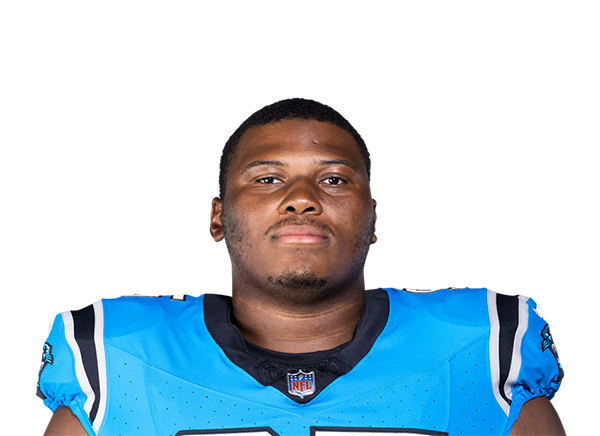
Derrick Brown
DT · Carolina Panthers · #95
Complete NFL Player Profile
Early Life & Background
Derrick Brown was born in Sugar Hill, a city in Gwinnett County, Georgia, where he spent his formative years before rising to athletic prominence. His upbringing in the Atlanta metropolitan area provided early exposure to competitive sports environments, particularly football, which became the focal point of his physical development. From an early age, Brown exhibited the traits that would later define his NFL career: exceptional size, strength, and a natural aptitude for defensive line play. Standing at 6’5” and weighing around 320 pounds by the time he reached high school, Brown’s physical profile immediately set him apart from his peers. His build suggested the potential for dominance at the interior defensive line position—a rare combination of height, weight, and athleticism that scouts typically associate with elite NFL prospects. Off the field, Brown’s background in Georgia shaped his work ethic and competitive mindset. The region has a rich tradition of producing NFL talent, particularly along the offensive and defensive lines, but Brown would emerge as a standout defensive tackle prospect through sheer physical dominance and technical refinement. His early life in a culture that reveres football, combined with his intrinsic physical gifts, laid the foundation for a career that would lead him to the National Football League as a top-tier draft choice.
High School Career
Derrick Brown attended Peachtree Ridge High School in Suwanee, Georgia, a program known for its competitive football culture within the state’s high school athletic landscape. At Peachtree Ridge, Brown blossomed into one of the most sought-after defensive tackle prospects in the nation. His high school career was marked by consistent performance against elite competition, a hallmark of future NFL readiness. Playing in Georgia’s GHSA Class 7A, widely regarded as one of the toughest classifications in high school football, Brown faced top-tier offensive linemen from across the Southeast, honing his ability to overpower and shed blocks. His combination of size, quickness, and raw power made him a disruptive force in the interior trenches. As a junior and senior, Brown accumulated numerous accolades, including selections to all-state teams and invitations to prestigious national combines and camps such as the Under Armour All-America Game. His performance at the U.S. Army All-American Bowl in 2015 further solidified his reputation as a dominant two-way force, where he recorded multiple quarterback pressures and showcased the explosiveness that would become a staple of his game. By the time he graduated, Brown had earned a five-star rating from major recruiting services, cementing his status as a consensus five-star prospect and one of the top defensive tackle prospects in the 2016 class. His high school tape consistently highlighted his ability to anchor against the run and disrupt in the passing game, traits that scouts projected to translate seamlessly to the collegiate level and beyond.
College Career
Derrick Brown attended Auburn.
NFL Draft
Derrick Brown entered the 2020 NFL Draft as one of the most polished and physically imposing defensive tackle prospects in recent memory. After three seasons at Auburn University—where he accumulated 104 tackles, 18.5 for loss, and 11.5 sacks—Brown declared for the draft following his junior year. His collegiate career confirmed the high expectations formed during his high school tenure. At Auburn, Brown solidified his reputation as a disruptive interior presence, earning All-SEC honors and becoming a key component of one of the SEC’s most formidable defensive lines. His senior season in 2019 was particularly impactful, as he recorded 41 tackles, 8.5 for loss, and 4.5 sacks while anchoring a defensive unit that ranked among the nation’s best in rushing defense.
Entering the draft process, Brown’s tape and combine performance—including a 4.98-second 40-yard dash and 31-inch vertical jump at 320 pounds—drew comparisons to elite NFL defensive tackles like Aaron Donald and Fletcher Cox. His combination of power, athleticism, and technique made him a top prospect at the position. On April 24, 2020, the Carolina Panthers selected Brown with the seventh overall pick in the first round of the NFL Draft, marking the second straight year Auburn produced a top-10 defensive tackle prospect after Marlon Davidson went 55th overall in 2019. The Panthers, in need of a foundational interior defensive lineman to pair with Brian Burns and Kawann Short, viewed Brown as a cornerstone for the franchise’s defensive rebuild. General Manager Marty Hurney called Brown “the centerpiece” of Carolina’s draft strategy, praising his ability to play multiple techniques, stop the run effectively, and generate pressure up the middle. Brown signed a fully guaranteed four-year, $29.5 million contract featuring a $19.66 million signing bonus, underscoring the Panthers’ long-term commitment to his development. With the seventh pick, Carolina secured a potential franchise anchor in the defensive line, aligning with the organization’s plans to pair Brown with emerging playmakers like Burns and Christian McCaffrey.
Professional Career
Derrick Brown’s NFL career began with immense promise, but it has unfolded with both flashes of brilliance and moments of inconsistent production, reflective of the challenges faced by young interior linemen transitioning to the professional level. Drafted to a Panthers team in transition under head coach Matt Rhule, Brown was expected to anchor the defensive front from day one. In his rookie season of 2020, Brown made his NFL debut on September 13, 2020, against the Las Vegas Raiders, entering the game as a rotational piece before gradually earning more playing time. By midseason, he had established himself as a regular starter, playing in all 16 games, including six starts. Brown finished his rookie campaign with 34 tackles, 2.5 sacks, and 9 quarterback hits, displaying the disruptive potential that made him a top draft choice. His ability to set the edge against the run and generate interior pressure began to show, particularly in run-heavy situations.
In 2021, Brown’s role expanded as he became one of the Carolina defense’s most reliable performers. Playing under new defensive coordinator Phil Snow, Brown started all 17 games and recorded 62 tackles, 4.5 sacks, and 23 quarterback pressures. His 2021 season included a career-high 7 tackles in Week 7 against the New Orleans Saints and a sack in Week 13 against the Tampa Bay Buccaneers. His performance helped stabilize a struggling defensive line as the Panthers navigated a challenging schedule. His sophomore year marked a significant leap in consistency, as he began to master NFL-level footwork and hand usage to complement his natural strength. Brown’s pass-rush repertoire grew to include swim moves and quick hands, allowing him to counter offensive linemen attempting to anchor him.
The 2022 season brought both progress and setbacks. Under new head coach Steve Wilks and defensive coordinator Ejiro Evero, Brown started all 17 games and posted 63 tackles, 4 sacks, and 28 pressures. He earned PFF’s highest-graded tackle run stop among interior defenders while ranking among the league leaders in run-defense grade. His dominance in the run game was a cornerstone of Carolina’s improved defensive performance. However, Brown’s pass-rush production remained uneven, as offensive linemen increasingly used double teams to neutralize his power. Despite this, he continued to be a reliable presence against the run and in short-yardage situations. His ability to occupy multiple blockers allowed other pass rushers, such as Brian Burns and Haason Reddick, to generate free access up the middle.
As of the 2023 season, Brown had started 55 of his 60 career games, firmly establishing himself as a foundational piece of Carolina’s defense. He played a pivotal role in the Panthers’ resurgence on defense, helping the unit finish in the top half of the league in several key metrics, including total defense and sack differential. Brown’s presence was especially felt in the red zone and on third-and-short, where his physicality allowed Carolina to control the point of attack. While not a prototypical interior pass-rushing force like Aaron Donald, Brown developed into a “war-daddy,” a term used to describe defensive tackles who thrive in anchoring the trenches, stopping the run with authority, and occupying blockers to free up edge rushers. His contract situation became a point of focus heading into the 2024 season, with the Panthers reportedly tagging him in early evaluations ahead of potential contract extensions. His consistency and durability—rare traits among high-first-round defensive tackles—have made him one of the franchise’s most valuable players and a leader in the locker room.
Playing Style & Strengths
Derrick Brown’s playing style is defined by an uncommon blend of size, strength, and functional mobility—attributes that allow him to excel in both run defense and interior pass rush. At 6’5” and 320 pounds, Brown possesses the rare physical profile of a defensive tackle who can play both three-technique and nose tackle effectively. This versatility enables defensive coordinators to deploy him in multiple alignments, including as a one-gapping penetrator or a two-gapping anchor, depending on the scheme. One of Brown’s most notable strengths is his anchor against the run. His lower-body power and ability to set a firm base allow him to defeat blocks from guards and centers, especially in two-way go situations. His hand placement—quick to strike and precise in disengaging—helps him shed offensive linemen and make plays in the backfield. In 2022, Pro Football Focus graded him as the highest-graded interior defender in run-stop situations, a testament to his dominance at the point of attack.
In pass rush, Brown is most effective as an interior disruptor rather than a pure edge rusher. He generates pressure primarily through bull rush and gap penetration, using his upper-body strength to bull opponents off the ball and into the quarterback. His 4.98-second 40-yard dash at the 2020 combine may not suggest elite athleticism, but his burst off the snap and closing speed in short areas (5- and 10-yard splits) are above average for his size. Brown’s swim move and club techniques have improved year over year, enabling him to counter slower-footed guards who rely on power rather than agility. While he may not accumulate double-digit sacks in a season, his ability to draw double teams limits the productivity of opposing guards, creating one-on-one opportunities for outside rushers. This “pancake block” effect—where Brown simply overpowers defenders and knocks them backward—has become a hallmark of Carolina’s offensive line strategy.
Brown’s football IQ and awareness are also significant assets. He reads guards and centers well, diagnosing screens and play-action fakes with growing precision. His lack of mental errors and tendency to stay disciplined in gap assignments make him a reliable presence in zone and gap schemes alike. Additionally, Brown has shown improvement in his stamina, which was a concern early in his career. His ability to maintain leverage and pad level throughout games has increased, reducing his tendency to lunge or overcommit. This technical refinement has translated into fewer penalties and more consistent production. Defensively, Brown’s presence in the middle allows Carolina to deploy more creative blitz packages, as offensive lines must account for him even when he’s not directly rushing the passer.
One of the more underrated aspects of Brown’s game is his durability. Despite playing in a physically demanding position, he has missed only five games in his first four NFL seasons, a remarkable track record for a top-10 draft pick. This resilience, combined with his leadership qualities, has made him a respected figure in Carolina’s locker room. Teammates often cite his intensity in practice and his willingness to mentor younger players, particularly fellow defensive linemen and rookie offensive linemen on the scout team. His quiet professionalism and steady production have earned him the trust of coaches and teammates alike, positioning him as a cornerstone of the franchise’s long-term defensive identity.
Personal Life
Off the field, Derrick Brown maintains a disciplined and low-key personal life, focusing primarily on family, community involvement, and professional growth. He was raised in a tight-knit family in Sugar Hill, Georgia, and maintains close relationships with his parents and siblings. Brown often credits his family—especially his mother—for instilling the work ethic and humility that have characterized his career. He is known for his strong Christian faith, which he has referenced in interviews and social media posts, emphasizing gratitude and perseverance in the face of adversity. Brown’s faith plays a central role in his approach to both life and football, shaping his resilience and perspective on the highs and lows of professional sports.
In Charlotte, where he has lived since joining the Panthers, Brown has become active in the local community, participating in charitable initiatives focused on youth development and education. He has partnered with organizations such as the Carolina Panthers Foundation to promote access to sports and STEM programs for underserved children in North Carolina. Additionally, Brown has hosted football camps in Georgia, providing free training and mentorship to young athletes from underserved backgrounds, emphasizing the importance of both athletic development and academic achievement. His involvement reflects a commitment to giving back to the communities that shaped him, mirroring the values he absorbed growing up.
Brown is also known for his modest lifestyle and professional demeanor. He avoids public controversies and maintains a respectful presence on social media, sharing content related to football, family, and faith while avoiding personal or political commentary. This approach has endeared him to fans and teammates alike, reinforcing his reputation as a “players’ player.” Brown has also been vocal about the importance of mental health, particularly for professional athletes facing the pressures of high-stakes competition. In a 2023 interview, he spoke about the need for balance between performance and personal well-being, advocating for resources and support systems within the NFL.
As of recent years, Brown’s public appearances have emphasized his growth as both a player and a person. He is often seen alongside teammates like Brian Burns and Jeremy Chinn, participating in community events and charity auctions. His relationship with the Panthers organization has been mutually beneficial, as he has become one of the face of the franchise’s rebuilding effort. With the team’s future increasingly tied to his development, Brown’s personal conduct and leadership role will only grow in significance as the Panthers aim to return to championship contention.
Legacy & Future Outlook
At the midpoint of his NFL career, Derrick Brown’s legacy is still being written, but he has already established himself as one of the Carolina Panthers’ most important and durable players. Drafted to be a franchise anchor, Brown has largely fulfilled that role, delivering consistent production despite playing in a system that has frequently changed defensive coordinators and positional alignments. His journey thus far reflects the arc of a player who was once considered a generational talent but has evolved into a foundational building block—more akin to the Warren Sapp or Kris Jenkins archetypes than a perennial Pro Bowl pass rusher. This evolution is not uncommon for elite interior defensive linemen, whose value is often best measured in disruption, durability, and leadership rather than sacks.
Looking ahead, Brown’s future with the Panthers hinges on two critical developments: his contract status and the team’s competitive trajectory. As of 2024, Brown is entering the final year of his rookie contract, with the Panthers holding his fifth-year option. Given his performance, durability, and leadership, most analysts expect Carolina to exercise that option, guaranteeing him a starting role through at least the 2025 season. Beyond that, the organization’s decision on a long-term extension will likely depend on its draft capital, salary-cap flexibility, and confidence in Brown’s ability to elevate alongside a core of young playmakers.
His role will be especially vital as the Panthers transition to a more aggressive, multi-pronged defensive scheme under defensive coordinator Ejiro Evero. Evero’s system, which blends gap and zone principles, places a premium on interior dominance and gap integrity—areas where Brown excels. If the Panthers are to contend for a playoff berth in the coming seasons, Brown’s ability to control games in the trenches will be decisive. His presence alone can dictate offensive game plans, as opponents must account for him in both run and pass designs.
From a statistical and evaluative perspective, Brown ranks among the league’s top-15 interior defensive linemen in run-stop percentage, pass-rush productivity, and durability since entering the league. His consistency in starting 80% of available games is particularly impressive for a top-10 pick. While he may never be a three-down, double-digit sack threat, his value lies in his ability to play every snap at a high level, reduce the effectiveness of opposing rushing attacks, and enable edge players to succeed. In an era where interior pass rush is increasingly prioritized, Brown’s role is more crucial than ever.
As he approaches the latter half of his prime, Brown’s focus is likely on polishing his technique, expanding his pass-rush repertoire, and mentoring the next generation of Panthers defensive linemen. His leadership qualities, combined with his on-field performance, position him as a candidate for team captaincy in the near future. Off the field, Brown’s community involvement and personal integrity strengthen his public image, making him a candidate for endorsement opportunities and media appearances as he transitions toward life after football.
Ultimately, Derrick Brown’s legacy may be defined as much by what he prevented as by what he produced. He is the kind of defensive tackle who doesn’t always register on highlight reels but quietly dominates games by occupying blockers, stopping the run, and creating space for others. In the history of the Carolina Panthers franchise, few players have carried the weight of expectations from day one with the same level of composure and professionalism. Whether he reaches a Pro Bowl or a Super Bowl stage, Brown’s impact on the Panthers—and on the NFL’s interior defensive landscape—will be measured in the tangible advantages his presence affords his team. As the franchise rebuilds around him, Derrick Brown stands not just as a starter, but as a pillar of its defensive identity and a symbol of sustained excellence in the trenches.
NFL career statistics not available at this time.
Frequently Asked Questions About Derrick Brown
What team does Derrick Brown play for?
Derrick Brown currently plays for the Carolina Panthers as a DT.
Where did Derrick Brown go to college?
Derrick Brown attended Auburn.
When was Derrick Brown drafted into the NFL?
Derrick Brown was Year: 2020 Round: 1 Pick: 7.
What is Derrick Brown's playing style?
Check the Playing Style section above for a detailed analysis of Derrick Brown's strengths.
How many NFL games has Derrick Brown played?
Derrick Brown continues to develop their game at the NFL level with 0 career games played.
Derrick Brown · Complete NFL Player Profile
Data via ESPN API & AI Research · Last updated: June 1, 2026
Bir yorum bırakın
E-posta adresiniz yayınlanmayacaktır. Gerekli alanlar * ile işaretlenmiştir